kako Camp Stove Review for Wide Pots
kako Camp Stove Review for Wide Pots
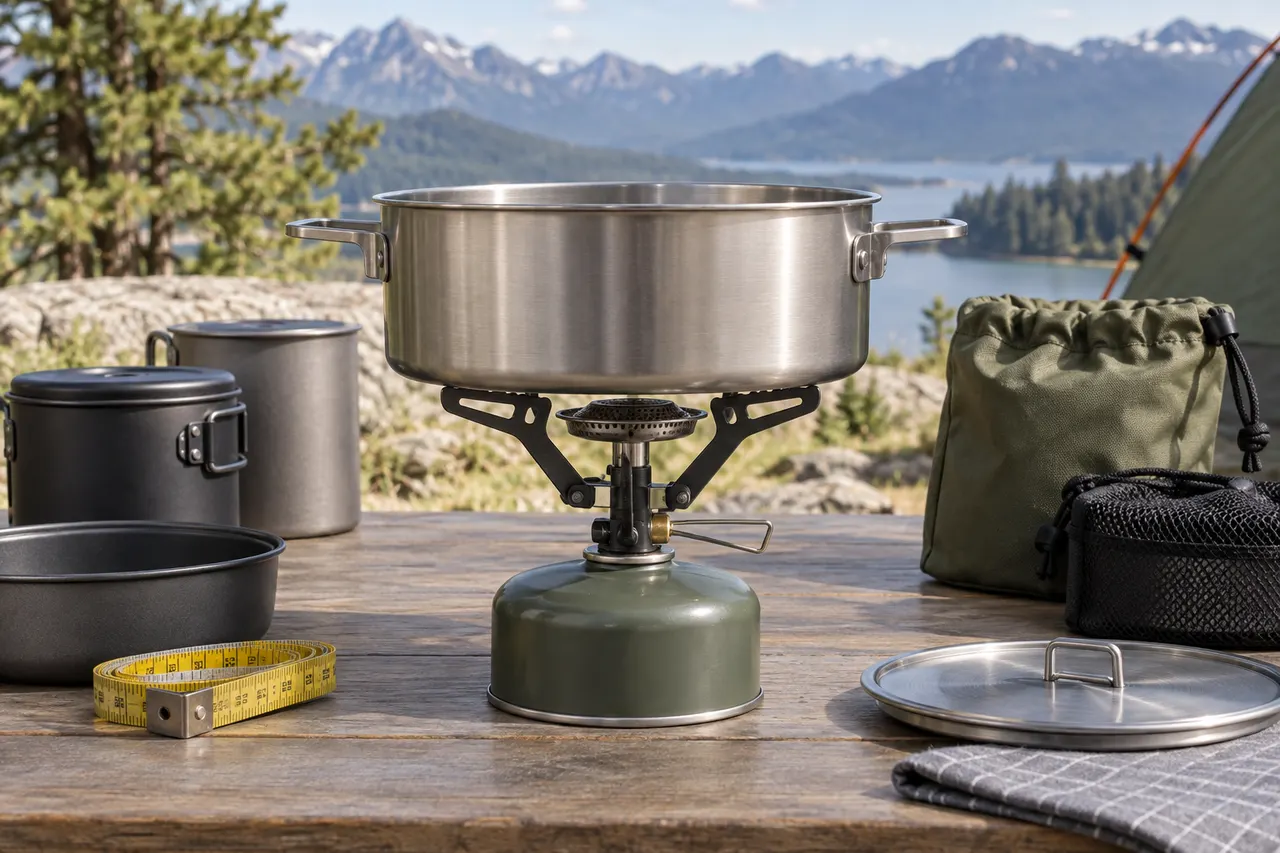
Caption: Before ordering a wide pot camp stove, you should check the stove support, pot bottom contact, and storage trade-offs.
First, define the real task for wide pot users
People who buy a wide pot camp stove usually don't just want to boil a cup of water; they want to make a real meal at camp: frying eggs, cooking noodles, making soup, heating a pot, serving multiple people, and even flipping ingredients in the same wide pot. The key to this task is not the firepower advertised on the page, but whether the stove can stably support your pot.
This article is for buyers comparing camp stoves on kako-sheets.org and preparing to decide if a stove can handle a wide pot based on the product page and warehouse QC photos. After reading, you should be able to do three things:
Judge whether the product page information is sufficient to support wide pot use
Know what to look for when you receive QC photos
Decide whether this stove is more suitable for solo meals, couple meals, or group camping
This article is not suitable for readers who need official lab test data, real gas consumption measurements, or confirmed long-term durability. This article does not claim to have actually purchased, ignited, cooked, or used the stove outdoors; the review is based solely on information that buyers can verify before ordering: page information, information the seller can supplement, and warehouse QC photos. Highly volatile information such as price, stock, shipping routes, freight, and after-sales window should be based on what you see on kako-sheets.org and the original product page on the day you order. The verification date of this article is 2026-09-08. 🔎
What observable information is the review based on?
A wide pot stove review cannot just look at the title, main image, or seller's promotional words. For buyers on kako-sheets.org, it is more useful to divide the evidence into three layers.
The first layer is the information visible on the product page, including the stove name, spec image, expanded dimensions, storage dimensions, support shape, fuel connection, material description, and included accessories. This allows a preliminary judgment of whether it is prepared for a wide pot, but cannot alone lead to a stability conclusion.
The second layer is information the seller can confirm supplementally, such as the outer edge width of the stove support when fully expanded, recommended pot bottom diameter, single-point load capacity, whether it fits your gas canister specifications, and whether there are anti-slip teeth or limiting structures. If the product page does not have this information, the buyer should ask clearly before paying.
The third layer is warehouse QC photos. The value of the kako-sheets.org process is that after the product arrives at the warehouse, buyers can observe the physical condition through photos. QC photos cannot prove ignition performance, nor can they replace safety certification, but they can help you spot whether the burner is deformed, the support is symmetrical, the storage parts are complete, and the packaging is clearly compressed. 📦
Why you can't just look at firepower description for wide pot cooking
Camp stove pages often highlight firepower prominently, but the core risk of wide pot use often lies beyond firepower.
A wide pot has a larger bottom, and the weight of ingredients and water is higher. If the stove support area is too small, the center of the pot bottom will press near the burner, and the outer rim will be unsupported, causing lateral force during flipping or stirring. No matter how big the flame is, it cannot compensate for the problem of narrow support points.
Also consider flame distribution. A narrow flame is suitable for small pots to boil water, but for wide pots, the center of the pot bottom tends to overheat while the edges heat slowly. The problem is not obvious when making soup or noodles, but when frying meat, stir-frying, or frying eggs, you may get burnt center and undercooked edges.
The third issue is the center of gravity. A wide pot is more easily affected by wind, uneven ground, handle pulling force, and stirring action. If the stove has a narrow base, high support, and the gas canister connection is off to one side, even if it looks fine when placed statically, it may not be suitable for group meals during actual cooking.
Therefore, wide pot buyers should change the order of judgment to: first look at support, then pot bottom contact, then firepower, and finally storage convenience.
Check stove support width, support points, and pot bottom contact on the kako product page
After entering the product information on kako-sheets.org, don't be attracted by the outdoor scene in the main image first. Look for the spec image and expanded view.
Focus on four items:
Maximum outer diameter of the stove support when expanded: it determines the range where the pot bottom can be supported
Number of support points: three-point support can form a basic plane, four or more points are often better for wide pots, but only if the heights of all points are consistent
Shape of support points: supports with serrations, bends, or anti-slip edges are more suitable for wide pots than smooth round rods
Pot bottom contact position: the pot bottom should rest on the support, not just press on the burner center or weak hinge
If the page only says "suitable for camping", "high firepower", "portable stove", but does not provide expanded dimensions and recommended pot bottom range, such descriptions are not sufficient to support a wide pot meal decision. Buyers should ask the seller to supplement images, preferably a photo of the stove expanded with a ruler in the same frame.
Also pay attention to units. The product page may mix centimeters, millimeters, inches, or only give approximate values. Before ordering, measure your pot bottom diameter and compare it with the outer edge width of the stove support. Don't just look at the pot mouth diameter, because many pots have a larger mouth than bottom, and the actual contact with the stove is the pot bottom.
Observe burner, support, and placement posture from QC photos
After the product arrives at the warehouse, QC photos are the second screening opportunity for wide pot buyers. Here, don't just confirm color and packaging; treat the photos as structural inspection material.
First, check whether the burner is centered, the mesh is deformed, or the nozzle area is visibly skewed. QC photos generally cannot show the ignition state, so don't interpret "looks complete" as "burns normally". It only shows that the appearance and component condition are generally visible.
Second, see whether the support is fully deployed. If the support angles are inconsistent, only two or three points may actually bear force when a wide pot is placed. For wide pots, slight unevenness of the support is more troublesome than for small pots, because the larger the pot bottom area, the more obvious the wobble.
Then look at the storage items. Portable stoves usually have a bag, box, adapter, or instruction sheet. Missing items may not affect the stove body, but will affect transport protection, carrying, and compatibility. After seeing the QC photos, buyers should compare with the accessory list on the product page and handle any missing items promptly at the warehouse stage. 🧾
If the QC photo angles are insufficient, request additional shots rather than guessing. The most useful additional shots are usually:
Full top-down view of the stove expanded
Side height view of the support
Close-up of the burner
Flat lay of accessories
Support width with a ruler in frame
Trade-offs among stability, storage, and cleaning
There is no universal configuration for a wide pot stove. Wider support is usually better for wide pots, but storage volume may increase. More complex support may improve stability, but cleaning crevices also increase. A more concentrated burner may be more direct for boiling water, but wide pot heating may be uneven.
The table below can be used as a trade-off judgment before ordering:
Concern | Benefit for wide pot | Possible cost | How to check before ordering |
|---|---|---|---|
Wide support | Improves pot bottom support range | Takes more storage space | Check expanded outer diameter and storage dimensions |
Multiple support points | Reduces single-point force | Wobbles if heights are uneven | Check top-down and side photos |
Anti-slip teeth | Reduces pot bottom sliding | More difficult to clean | Check support edge details |
Low center of gravity | Better for stirring and group pots | May sacrifice ground clearance | Check base height and gas connection method |
Simple structure | Easier to wipe and store | Wide pot stability may be limited | Check support length and locking method |
If you mainly cook noodles for one, lightweight and storage may be more important. If you want to fry and stir-fry for two, support area and flame coverage are more important. If you plan to share a large pot among multiple people, stability, pot bottom contact, and shipping route availability should take priority over portability. 🔥
Cleaning cannot be ignored either. Wide pot cooking is more likely to boil over, drip oil, or scorch the pot bottom, and if there are too many crevices around the burner and support, maintenance will be more troublesome later. Buyers should observe from product images whether there are deep grooves, dense rivet points, or non-removable structures that are hard to wipe.
Checklist of questions to confirm with the seller
If the product page information is insufficient, it is not advisable to treat the stove as a wide pot meal solution directly. You can confirm the following questions with the seller before ordering:
What is the outer edge width of the stove support when fully expanded?
What is the recommended pot bottom diameter range?
Does the support have a locking structure? Will it automatically spring back after expansion?
What is the recommended load capacity per support point or for the whole unit?
Is it compatible with the gas canister or adapter you plan to use?
Does the set include a storage box, storage bag, adapter, or spare parts?
Are there real photos of the expanded stove, rather than rendered images?
Is it allowed to request after-sales service at the warehouse stage due to structural deformation or missing parts?
These questions are not for pursuing perfect specs, but to avoid buying a stove that is only suitable for boiling water in a small pot but is mistakenly used for wide pot meals.
In the kako-sheets.org purchasing process, it is recommended to keep the seller's replies, product page screenshots, and QC photos in the same order record. If you need returns, exchanges, missing parts, or after-sales communication later, these evidences are more useful than a vague statement of "unstable". 🛠️
Finally decide based on solo meals, couple meals, and group camping
If you are a solo meal user, your pots are usually small and the need for a wide pot is not strong. As long as the stove support can stably hold the pot bottom when expanded, and it is lightweight, simple in structure, and complete in accessories, you can proceed to check shipping costs and available routes. You don't need to sacrifice much volume for group pot stability.
If you are a couple meal user, put stove support width and support points first. Pots for couple meals are often wider and involve more ingredient flipping, so the stove cannot just satisfy static placement. It is recommended to obtain at least expanded photos, support width photos, and QC top-down photos before deciding whether to ship in one package.
If you are a group camping user, be cautious with this type of portable stove. Group pots are heavier, have wider bottoms, and require more frequent stirring. Unless the product page and seller's supplemental information clearly support a larger pot bottom, and QC photos show that the support is flat and the structure is complete, it is not recommended to use it as the main stove for groups. For group scenarios, also consider parcel value, shipping restrictions, customs documentation, and after-sales difficulty; don't judge solely by the stove's unit price.
The final judgment can be simple:
If the product page lacks expanded dimensions, it is not suitable to order directly for wide pot meals.
If the seller cannot confirm the recommended pot bottom range, lower expectations or switch to another model.
If QC photos show uneven support, deformation, or missing parts, handle after-sales service first.
If only for boiling water and simple solo meals, a lighter solution is acceptable.
For couple or group meals, prioritize stoves with wider support and more complete evidence.
Whether this kako wide pot camp stove is worth buying cannot be decided by words like "camping", "high firepower", or "portable". The real decision points are: can your pot bottom be stably supported, can warehouse photos prove the support condition is normal, and can the seller provide the key dimension information. Only if these conditions are met can it become a tool for camp meals; if evidence is lacking, it is better regarded as a lightweight stove for small pots, not a main stove for wide pots.
Browse our latest products and find your next favorite item.